
 Join
Join
What Is the Dorsal Root Ganglion? How Friedreich Ataxia Affects It


Key Takeaways
- Friedreich ataxia is a rare inherited condition that damages the nervous system over time, and one of the main areas it affects is a part of the nervous system called the dorsal root ganglia, which sends important sensory signals from the body to the brain and spinal cord. View all takeaways
If you have Friedreich ataxia (sometimes abbreviated FA or FRDA), you know firsthand how this disorder can affect your limbs and your ability to walk. But have you heard of the dorsal root ganglion? This is one of the main tissues affected by Friedreich ataxia.
Friedreich ataxia affects both the central nervous system (brain and spinal cord) and the peripheral nervous system (nerves outside the brain and spinal cord). Dorsal root ganglia (the plural form of ganglion) are part of the peripheral nervous system.
In this article, we’ll focus on what the dorsal root ganglia are, how Friedreich ataxia affects their development and function, and how these changes contribute to Friedreich ataxia symptoms.
Thanks! You've successfully submitted your vote.
Sign up to view the results!
Continue with EmailWhat Causes Friedreich Ataxia?
Friedreich ataxia is a rare disease that leads to progressive neurodegeneration, meaning that it damages the nervous system and gets worse over time. Before discussing how the dorsal root ganglia are affected, it’s helpful to understand what causes Friedreich ataxia.
Friedreich ataxia is an inherited genetic disorder caused by mutations (changes) in the FXN gene. The FXN gene provides instructions for the production of frataxin, a protein that helps the energy-producing parts of cells, called mitochondria, work properly.
Because of these changes, people with Friedreich ataxia don’t produce enough frataxin. Lacking frataxin, nerve and heart cells may start to degenerate.
Changes in the FXN gene can vary, resulting in different amounts of frataxin. The severity of Friedreich ataxia is linked to the variation in the FXN gene, so some people have later onset and milder symptoms, and others have earlier onset and more severe symptoms.
What Is the Dorsal Root Ganglion?
The sensory neurons (nerve cells) in the dorsal root ganglia send information from your body to your central nervous system, including signals about:
- Temperature
- Fine touch
- Pain
- Vibration
- Pressure
A dorsal root ganglion is a cluster of sensory nerve cell bodies. Dorsal root ganglia are arranged in pairs on either side of the spinal cord.
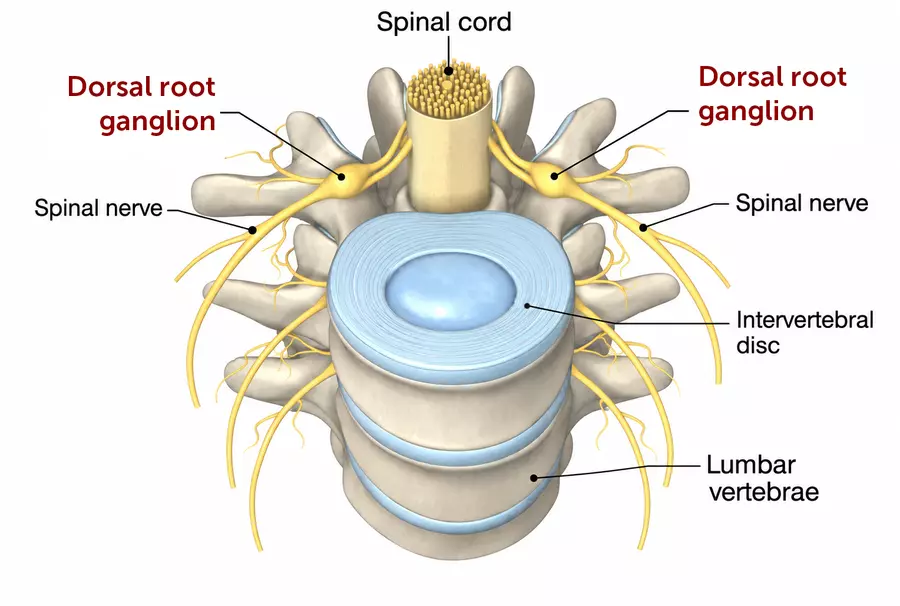
The dorsal root ganglion connects to the spinal cord through a dorsal root. Most ganglia sit near the bony openings between the spinal vertebrae.
The neurons in the dorsal root ganglia vary in size. Each nerve cell body is wrapped in satellite glial cells that help prevent electrical signals from passing directly between neighboring neurons.
How Does Friedreich Ataxia Affect the Dorsal Root Ganglion?
Friedreich ataxia affects multiple regions of the central nervous system and peripheral nervous system.
Studies using MRI scans have shown damage to the spinal cord, parts of the cerebellum (the area of the brain that helps coordinate voluntary movement and balance), and the brainstem in people with Friedreich ataxia.
In Friedreich ataxia, the dorsal root ganglia have fewer and smaller nerve cells and more supportive cells known as satellite glial cells.
The dorsal root ganglia are one of the main tissues affected in Friedreich ataxia. Neurology researchers have noted several abnormalities in the dorsal root ganglia of people with Friedreich ataxia, including:
- Fewer neurons
- Smaller average size of neurons
- An atypical gray color
- More satellite glial cells
The Role of Satellite Glial Cells
Satellite glial cells play multiple roles in a healthy dorsal root ganglion, including:
- Providing nutritional support for sensory neurons
- Balancing levels of ions (charged particles) and neurotransmitters (chemical messengers)
- Helping regulate sensory neurons
In healthy people, satellite glial cells typically cover the surface of sensory nerve cell bodies in a single layer. In people with Friedreich ataxia, these cells multiply and form uneven layers around the neurons. As neurons are lost, small clusters of cells called nodules can remain.
Researchers have linked abnormal satellite glial cells and inflammation with damage to neurons in Friedreich ataxia.
How the Dorsal Root Ganglia Develop in Friedreich Ataxia
Based on animal studies, researchers think that changes in the dorsal root ganglia may be related to a lack of frataxin during early development before birth.
Researchers think that changes in the development of dorsal root ganglia and the spinal cord in Friedreich ataxia may involve the failure of a structure called the boundary cap. During development, boundary cap cells are a source for both glial support cells and neurons, and they also act as a barrier between the central nervous system and peripheral nervous system.
In Friedreich ataxia, failure of the boundary cap may allow cells from the central nervous system to grow into the dorsal roots.
Other Effects of the Dorsal Root Ganglia During Development
The underdevelopment of the dorsal root ganglia in Friedreich ataxia may also affect how other structures develop.
For example, the dorsal column, a major sensory pathway in the spinal cord, is not as thick as usual in people with Friedreich ataxia. Researchers think it is thinner because it has fewer myelinated fibers. Myelin is a protective covering around nerve fibers that helps electrical signals travel faster.
This shortage of myelinated nerve fibers may be related to underdevelopment of the dorsal root ganglia, which are the source of most of these fibers.
Other nerve cells in the sensory pathway might also be indirectly affected by these developmental problems.
For example, nerve cells in the lower brainstem are often smaller in people with Friedreich ataxia. Researchers think this may be due to transneuronal atrophy, in which nerve cells shrink after losing signals from other nerve cells.
More research is needed before scientists fully understand how the spinal cord changes as the disease progresses.
Which Friedreich Ataxia Symptoms Are Linked to the Dorsal Root Ganglia?
Along with degenerative changes, underdevelopment of the dorsal root ganglia neurons leads to damage to the sensory peripheral nerves.
Changes to both the dorsal root ganglia and nerve tracts like the dorsal column lead to fewer sensory signals to the cerebellum. This is likely why people with Friedreich ataxia can lose sensory functions over time.
This loss of sensory function greatly affects proprioception — the body’s ability to perceive its position and movement in space. Specifically, the lack of myelinated fibers in the dorsal column of the spinal cord is thought to cause a significant decrease in the ability to sense vibrations and the angle of the joints in your limbs.
Changes to the dorsal root ganglia lead to problems with the sense of proprioception, or where the body is in space, as well as other senses.
Other related symptoms may include:
- Loss of certain reflexes
- Weakness in the legs
- Muscle stiffness (spasticity)
However, some of these symptoms might be caused by damage to areas elsewhere in the central nervous system.

Talk to Your Doctor About Treatment Options
In recent years, a treatment called omaveloxolone (Skyclarys) has become available to help slow progression of Friedreich ataxia. It is approved by the U.S. Food and Drug Administration (FDA) for people ages 16 and older. Other therapies are currently under study in clinical trials.
Talk to your doctor to find out whether starting omaveloxolone or joining a clinical trial might be right for you.
- Friedreich Ataxia: Clinical Features and New Developments — Neurodegenerative Disease Management
- Central Nervous System Therapeutic Targets in Friedreich Ataxia — Human Gene Therapy
- Topic 1.4. Neuromorphology of the Nervous System in Friedreich Ataxia — Clinical Management Guidelines for Friedreich Ataxia (FRDA)
- Dorsal Root Ganglion: What Is It, Where Are They Located, Function, and More — Osmosis by Elsevier
- Friedreich’s Ataxia — National Organization for Rare Disorders
- Dorsal Root Ganglion — Kenhub
- Spinal Cord Damage in Friedreich’s Ataxia: Results From the Enigma-Ataxia — medRxiv (Preprint)
- Friedreich Ataxia (FA) — Rare Disease Advisor
- Single-Cell Analysis of Dorsal Root Ganglia Reveals Metalloproteinase Signaling in Satellite Glial Cells and Pain — Brain, Behavior, and Immunity
- Friedreich’s Ataxia: Pathology, Pathogenesis, and Molecular Genetics — Journal of the Neurological Sciences
- Dorsal Root Ganglia in Friedreich Ataxia: Satellite Cell Proliferation and Inflammation — Acta Neuropathologica Communications
- Boundary Cap Cells in Development and Disease — Current Opinion in Neurobiology
- Proprioception — Cleveland Clinic
- Skyclarys Prescribing Information — U.S. Food and Drug Administration
Related
- What are common symptoms of ataxia? See answer
- Why am I so tired and what can I do about it? See answer
- What tests are used for ataxia and what do they show? See answer
- What complications can come from ataxia? See answer







 Your Privacy Choices